Product-led growth (PLG) lets the product drive acquisition, conversion, and expansion with minimal sales involvement. Sales-led growth (SLG) relies on a sales team to guide prospects through the buying journey. Both are powerful strategies, but many companies face a critical failure point: when PLG users hit enterprise scale and need sales assistance, the handoff often breaks momentum, trust, and revenue potential.
Companies that master seamless, graduated handoffs between PLG and SLG achieve 130%+ Net Revenue Retention while scaling both motions. Here’s how to make it work.
The Three Ways Typical Handoffs Fail
1. Momentum Disruption
PLG users expect instant gratification. When sales processes suddenly stall their expansion, they lose the momentum that drove their initial success.
2. Context Loss
Sales reps inherit accounts without understanding the PLG journey—what features were adopted, usage patterns, or expansion signals. This forces them to start from scratch instead of leveraging existing product knowledge.
3. Trust Erosion
Users feel deceived when self-serve simplicity suddenly becomes “contact sales.” A typical failed handoff: a user hits an arbitrary threshold ($10K ARR, 50 seats), gets assigned to a sales rep, and receives a cold email introducing a “new account manager”.
Five Enterprise Signals That Predict Handoff Readiness
Sales reps need real-time product usage data to identify when prospects are ready to buy. Track these leading indicators:
Combining team expansion + feature complexity + support escalation predicts enterprise readiness with 78% accuracy.
What Sales Reps Need from Product Signals
A. Persona Targeting for Cross-Sell
Track how key personas (CTOs, VP Engineering, Engineering Managers) use new features. Create Slack alerts for salespeople when specific titles engage with new functionality.
B. Account Adoption Signals for Expansion
Monitor organic invites sent to new users, saturation of usage based on caps, and new feature engagement. These indicate expansion readiness.
C. Custom PQLs (Product Qualified Leads)
Create custom PQL models using multiple signals simultaneously:
-
Accounts with >500 employees + 5 new users added last week + core feature used first time
-
Accounts using >10GB data/month with tailored outreach sequences
A strong PQL definition captures three categories:
-
Customer fit: Industry, geography, company size, user role/title
-
Product usage: DAU, frequency, recency, time spent, feature usage, invites sent
-
Buying intent: Visited pricing page, clicked “talk to sales,” new seats added
D. Real-Time Usage Data Benefits
-
Right timing: Find optimal moments to upsell/cross-sell instead of waiting for renewal
-
Feature correlation: Discover features most correlated to conversion
-
Active usage insight: See if provisioned users are actively using the product
-
Objective data: See what customers actually do, not just what they say
What Product Teams Need from Sales
Feedback on Product Gaps
Sales teams should record product gaps or opportunities. This input reveals what features enterprise deals are requesting.
Deal Context & Customer Pain Points
Sales must communicate buyers’ pain points for use case-oriented discussions. Sales reps become trusted advisors who understand core use cases.
Enterprise Market Intelligence
-
What initiatives companies are investing in (from hiring signals)
-
What tech stack prospects use (for integrations/consolidation narratives)
-
How companies talk about challenges and objectives (for personalized messaging)
Closed-Loop Feedback
Product teams need handoff success rates, time-to-close for handed-off accounts vs. cold prospects, and post-handoff satisfaction scores.
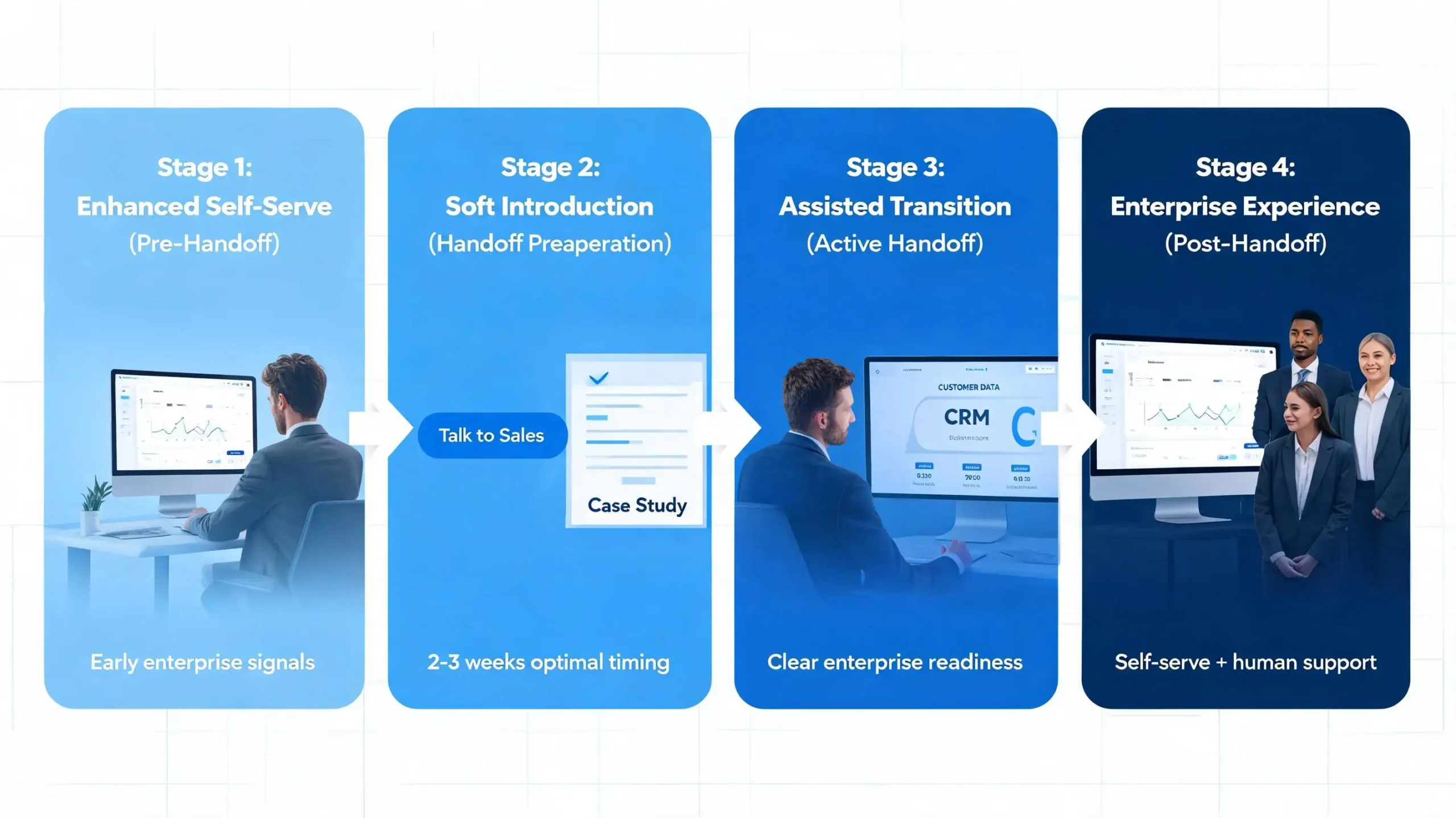
The Four-Stage Graduated Handoff Framework
Instead of binary handoffs, build graduated transition experiences:
Optimal timing: Users engaged in Stage 2 for 2-3 weeks before Stage 3 show highest conversion rates.
Real Results: A Case Study
A project management SaaS with strong PLG but struggling enterprise growth achieved:
Sales reps referencing specific PLG journey elements achieved 2.3x higher conversion rates.
Five Common Handoff Mistakes to Avoid
-
Arbitrary handoff triggers: Simple thresholds without behavioral readiness catch users not ready
-
Abrupt experience changes: Switching from self-serve to “contact sales” overnight kills momentum
-
Context-free sales outreach: Generic enterprise pitches feel tone-deaf
-
Feature gating without warning: Suddenly restricting features breaks trust
-
One-size-fits-all messaging: Same pitch for all users regardless of PLG journey
Six KPIs That Measure Handoff Effectiveness
-
Handoff Conversion Rate: 40-60% for well-executed handoffs (convert to enterprise within 90 days)
-
Context Utilization Score: Reps referencing PLG data = 2.3x conversion
-
Transition Satisfaction Score: 80%+ rating transition as positive
-
Post-Handoff Retention Rate: Higher 12-month retention than cold enterprise
-
Revenue Per Handoff: Context-rich handoffs command premium pricing
-
Time to Enterprise Value: Faster than cold enterprise due to existing product knowledge
The Bottom Line
The enterprise handoff crisis isn’t inevitable. By tracking the right signals, building graduated transitions, and creating feedback loops between sales and product teams, companies can scale both PLG and SLG without sacrificing momentum or trust. The result: faster enterprise revenue growth, shorter sales cycles, and customers who feel the transition was seamless—not disruptive.


Leave a Reply